

By Dresden Trust trustee Sinclair McKay, author of “Dresden: The Fire and the Darkness”
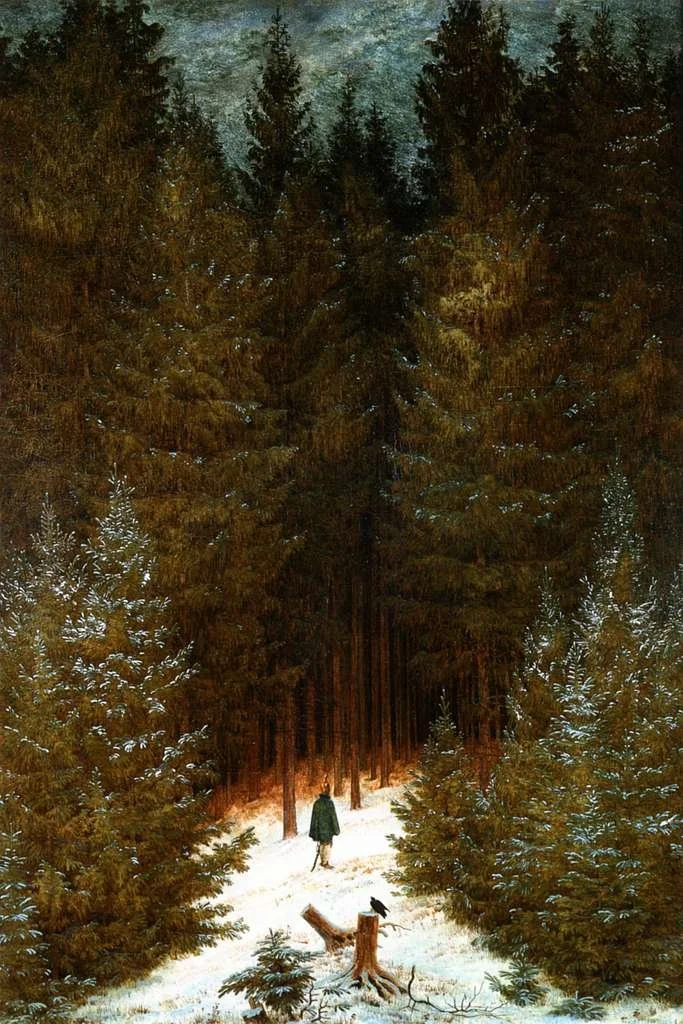
Der Chasseur im Walde, Caspar David Friedrich
THE artist Caspar David Friedrich – who lived in Dresden for the greater part of
his life – conveyed eerie romanticism through dream-like light: rich amber
sunsets, steely snow-laden skies over abandoned ruins. He conjured landscapes
of foreboding. One of his paintings dwells elliptically upon a war that had
shaken the city.
Chasseur in the Forest depicts a vast dark forest, trees standing like sentinels,
the ground bright with snow, and a solitary figure – a French cavalry officer,
without his horse, and seemingly about to walk into the darkness. The only
other living thing is a black crow, cawing. The painting is understood as
presaging death. This followed a turbulent period where Dresden and its
outskirts were pulled into the vortex of Napoleonic battle against the Prussians
and Russians in 1813.
The painting was first shown in a year later, following Dresden’s liberation from
French forces, in the city’s ‘Exhibition of Patriotic Art’. The snow was said to
suggest the harrowing retreat of Napoleon’s armies from Moscow. The solitary
cavalryman, his back to us, seems resigned to destiny.
While the city of Dresden now is understood as a triumph of regeneration after
the obscene horrors of bomber destruction in WW2, its artistic heritage and long
textured history also invites us more broadly to meditate upon the threads that
hold peace and civilisation together.
Europe currently seems to be tentatively staring over the edge of the abyss:
imagining, incredibly, that war could come again. The form this conflict may
take is foggy: some fear Russia, others are anxious about hybrid conflict with
other actors. The threat is envisaged from multiple directions. The conflict in
Ukraine seems a terrible vision of what may happen elsewhere. The important
thing is that even just ten or fifteen years ago, such fears would have seemed
preposterous. Now they are universal.
The Caspar David Friedrich painting of 1814 is a world in which the threads of
civilisation had briefly been snapped. Those threads had to be re-woven.
Destruction is simple. Peace is a continuing act of creation and creativity. And
the art of Dresden – the Caspar David Friedrich room in the Albertinum is
breathtaking – is also a record of that vision: after the periodic storms of war
have passed, the artists are there to remind us of the truer wellsprings of life.
Remembrance is sacred: yet Dresden’s art and architecture are there for the
living yet to come.